
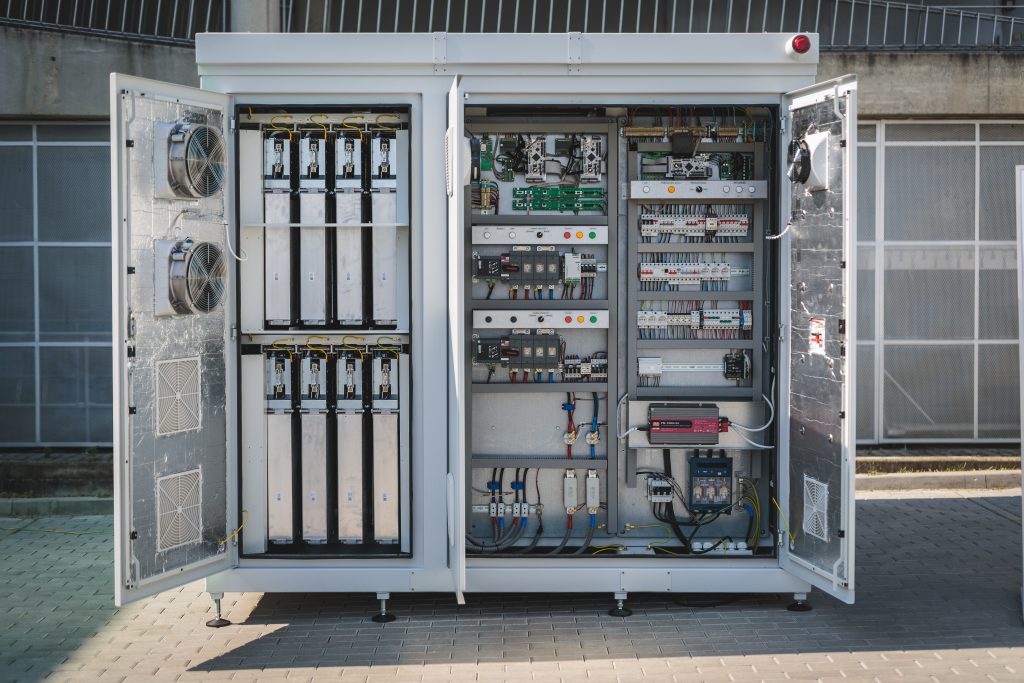
Developing the control system for our IES battery storage isn’t just a question of electrochemistry and power electronics. Who watches over the system to keep it running safely and reliably around the clock matters just as much — for us, that’s the ComAp InteliNeo 530 controller.
When we started developing our own Industrial Energy Storage (IES) system, we ran into a common problem with building anything new: at first we had to adapt to the controller’s capabilities more than we were used to with the open systems of standard PLCs. After a short initial phase, though, we started making full use of its predefined functionalities — regulators, power configurations, battery/inverter/grid protections, Modbus parameters, AC synchronization, and history logging. As a result, developing the control algorithms took significantly less time, and the chance of overlooking a bug dropped noticeably.
The goal: a safe storage system ready for batteries from anywhere
The goal of the project was to develop a maximally safe and reliable battery storage system flexible enough to work with a wide range of 2nd-life battery modules from electric vehicles as well as new batteries. The result is a genuinely European system ready for different battery sizes, capacities, chemistries, and cell ages — bringing long-term product sustainability, cost efficiency, and adaptability in a currently very turbulent battery market.
How we approached it
In the design, we made maximum use of the battery container’s available space, doubling both power and capacity with a minimal increase in container length. To ensure optimal temperature and longer battery life, we integrated climate control units.
We implemented the ComAp InteliNeo 530 controller into the system, and for remote monitoring and control we used the WebSupervisor platform, which enables efficient real-time monitoring, diagnostics, and management of the entire storage system.
Scope of supply
The supply included ComAp control and communication components integrated into the battery system:
- InteliNeo 530 BESS
- 2× Inteli IO8/8
- CM-RS232-485
- Inteli AIN8TC
- CM3-Ethernet
For management, monitoring, and configuration of the battery storage systems, we used the following software tools:
- WebSupervisor — for remote monitoring and system control
- WinScope 1000 — for visualizing and analyzing operational data
- InteliConfig — for configuring and parametrizing the control units
Why ComAp
We’ve been using ComAp controllers in our motor generators for a long time, well before we started developing battery storage systems. When we were looking for a suitable controller solution and supplier for the new battery system, we found the InteliNeo 530 BESS — a product that matched our needs exactly.
We have strong know-how in battery technology, but we didn’t want to build our own monitoring and management system from scratch. ComAp’s solution met our expectations for reliability, functionality, and stability. We see great added value in remote oversight via WebSupervisor, the ability to measure all variables in detail in real time using WinScope 1000, and remote system configuration through InteliConfig. These tools let us focus fully on what matters most to us — developing and manufacturing reliable, highly efficient, long-lasting battery storage systems.
Developing a battery storage system is a complex process that requires a broad range of knowledge — from electrochemistry, electronics, and inverters to thermodynamics and regulatory requirements.
What we learned
Our development team gradually built up detailed know-how across all these areas, which we now apply when designing and delivering further projects — from smaller IES installations to large-scale battery storage systems in the multi-MWh range.
